
Sumadhura Kannamangala Master Plan

How to evaluate an approximately 75-acre, 18-24-tower biophilic Whitefield township before the sanctioned drawing is public.

Indicative approximately 75-acre master plan visual
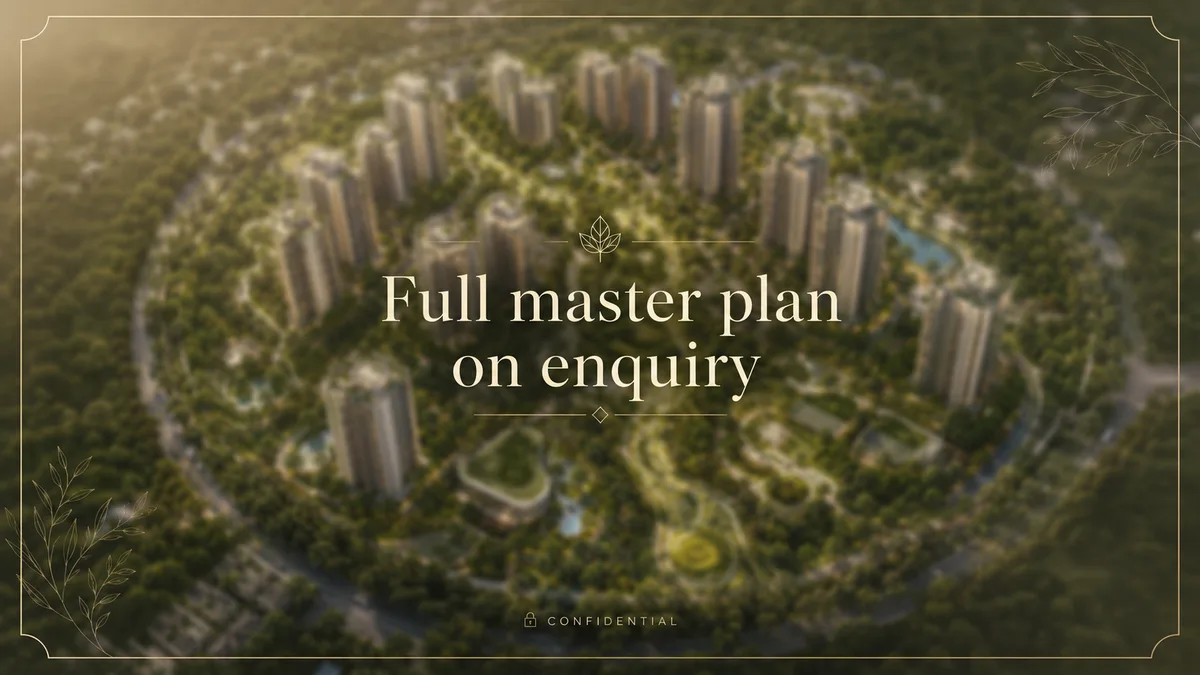
Sumadhura Kannamangala master plan site layout
Blurred pre-launch teaser for buyer orientation only: tower clusters, central green spine, themed forest pockets, clubhouses, water bodies and internal movement. The full master plan is shared on enquiry; use the official sanctioned plan for binding decisions.

Sumadhura Kannamangala master plan: the real questions

A master plan is not a decorative aerial view. For Sumadhura Kannamangala, the question is whether approximately 18-24 high-rise towers on approximately 75 acres can create a calm biophilic township while handling vehicles, visitors, fire movement, services and resident amenities, with 60%+ of the land held as landscaped and open space. From a planning angle, the adjacency of the 70-acre Atal Bihari Vajpayee Botanical Garden keeps the green reference real: internal roads, open-space placement, amenity access, and tower orientation all affect how the address will live after handover. Sumadhura Panorama Phase 2 is useful for the site-planning lens because buyers should read open space, movement, parking, and amenity placement as everyday-use details, not brochure decoration.

The sanctioned plan should show tower spacing, permanent entry, basement ramps, drop-offs, service routes, utility zones, amenity placement and resident movement.

Plan elementWhat to inspectWhy it matters
Tower spacingDistance between facing homesPrivacy and ventilation
Entry / exitResident, visitor and service routesDaily traffic quality
Basement rampsPosition and noise impactPremium experience
Amenity placementClubhouses, pools, kids areasCapacity and convenience
Utility zonesSTP, DG, waste, transformerNoise, smell and view impact

An approximately 75-acre, 18-24-tower township can work well if the towers are clustered into phase precincts and internal movement is calm. The sanctioned plan should separate resident entry, visitor movement, service access, fire driveways, basement ramps and the pedestrian green spine.

The master-plan question is whether the green space is usable after setbacks, ramps, service zones and fire movement. A biophilic township should protect privacy, shade, walking loops and senior spaces without forcing everyone through the same crowded core - here the central green spine and themed forest pockets are designed to keep the ground plane reading as forest rather than as a dense apartment grid.

Tower clustering and privacy
Permanent entry and exit
Two-basement ramp position
Clubhouse placement and phasing
STP, DG, waste and service zones

Sumadhura Kannamangala open space and landscape

The useful open-space question is whether it is accessible and shaded. At 60%+ open coverage, the central green spine, themed forest pockets, water bodies, walking loops, kids' play areas and senior seating have a different value from leftover setbacks - and the 70-acre botanical garden next door, with its 3 km jogging track and five ponds, is treated as borrowed landscape that extends the township's own forest theme.

Sumadhura Kannamangala phasing and delivery

The township is delivered in 3-4 phases over a ~6-8 year horizon, with each phase filed phase-wise at Karnataka RERA before its launch; Phase 1 possession is indicatively 2030-2031, with full build-out 2032-2034. Early buyers should know what amenities arrive first and what construction continues around them - each phase is planned as a self-contained precinct with its own tower cluster, clubhouse, landscape court and basement parking.

Sumadhura Kannamangala: Contact us for latest documents

Request the current RERA status, cost sheet, floor-plan sheet, tower release note, payment schedule and site-visit slot before you block an EOI.

Contact us

Sumadhura Kannamangala FAQ

What is Sumadhura Kannamangala?

Sumadhura Kannamangala is a proposed biophilic apartment township by Sumadhura Group at Kannamangala, off Whitefield-Hoskote Road, Whitefield. The working brief describes approximately 75 acres, approximately 18-24 phased towers, and 2, 3, 3.5 and 4 BHK homes with 60%+ open and green coverage.

Where is Sumadhura Kannamangala located?

The site is being tracked at Kannamangala, off Whitefield-Hoskote Road, Whitefield, East Bengaluru, beside the 70-acre Atal Bihari Vajpayee Botanical Garden and within 2-4 km of the Kadugodi Purple Line metro terminus. Buyers should confirm final survey numbers, site boundary and approach road in the official documents.

Is Sumadhura Kannamangala RERA approved?

Karnataka RERA registration is awaited; a phased township of this scale files phase-wise before each phase's launch. Do not treat any RERA number, possession date, tower height or unit count as final until the official filing is published.

What is the expected price of Sumadhura Kannamangala?

The pre-launch indicative pricing is from Rs 95 Lakh onwards, with a headline rate band of Rs 8,500-11,000 per sqft. The final payable cost must be checked against the official cost sheet because GST, stamp duty, registration, floor rise, parking, clubhouse charges, corpus and interiors can materially change the budget.

Which configurations are expected?

The expected mix is 2, 3, 3.5 and 4 BHK across the township's full breadth. The official floor-plan sheet should confirm carpet area, saleable area, balcony area and parking allocation.

Who should shortlist this project?

The strongest fit is a Whitefield-linked family or long-horizon investor looking for a large-format biophilic township near the ITPL / Kadugodi / metro catchment. It is less suitable for buyers who need ready possession or full certainty before RERA publication.

Ask a project questionContact us

Sumadhura Kannamangala density, tower clustering and FAR economics

Read at the township level, Sumadhura Kannamangala's density profile sits in a buyer-friendly band. Approximately 5,000 residences across approximately 75 acres translates to a per-acre density of roughly 65-70 homes - sufficient for the FAR economics that make multiple clubhouses and a two-basement parking podium per precinct commercially viable, but well short of the 110-130 homes-per-acre profile of the over-densified peripheral launches that struggle with lift-density, parking circulation and amenity capacity. The approximately 18-24 high-rise towers at 2 Basement + Ground + 27-30 floors are clustered into phase precincts, each gathered around a shared landscape court and clubhouse, a configuration that allows two passenger lifts plus a service lift per tower without lift wait times degrading beyond 30-45 seconds at peak.

Tower spacing is the single most underweighted variable in a Whitefield premium launch. At 27-30 floors per tower, the inter-tower distance needs to be generous to prevent the facing-balcony privacy and ventilation issues that have plagued several earlier-generation Whitefield projects - here the high-rise stack absorbs the density vertically so spacing can be kept ample. The sanctioned plan, when public, should be inspected for the centre-to-centre distance between towers within each precinct - anything cramped deserves a hard buyer question.

Open-and-landscaped coverage of 60%+ is achievable on an approximately 75-acre, ~5,000-unit site by concentrating the residences into compact high-rise plates - keeping the tower footprint near 18% of the land and freeing the remainder for the central green spine, themed forest pockets, water bodies and amenities. This clustering decision shapes whether the green spine is a continuous landscaped corridor with mature canopy or a fragmented series of leftover setbacks dressed up with brochure language. The mature-canopy promise - forest-grade planting at handover - is technically achievable but requires the developer to plant during the early construction phase rather than the typical practice of last-minute landscaping before snagging. Ask for the landscape contractor name and the phased planting calendar at the EOI stage.

Sumadhura Kannamangala services, utilities and IGBC Gold target

Behind the brochure photography sit the services and utilities that determine the per-square-foot maintenance economics over a 25-year holding period. Sumadhura Kannamangala's planned service stack is solid for the price band: phase-wise sewage treatment plants sized for full occupancy with treated-water reuse for landscape irrigation and flushing, targeting Zero Liquid Discharge; campus-wide rainwater harvesting with distributed recharge wells reinforced by the five-pond botanical-garden context; designed water bodies doubling as recharge assets; 100% common-area LED lighting; solar provisioning for clubhouses and external lighting; organic waste composting at source with dedicated wet-waste handling; and source-segregation across the towers.

The IGBC Gold (or higher) pre-certification target, if delivered, typically reduces operating energy and water consumption by 15-22% versus a non-certified peer, which translates to roughly Rs 1.50-2.50 per sqft per month of maintenance saving for the resident at full occupancy. The two-basement parking podium per tower is what allows the 60%+ open-coverage commitment to hold across ~5,000 homes while keeping the green ground plane vehicle-free. EV-charging provisioning per the 2026 Sumadhura standard covers the basement bays at launch, scalable upward - a sensible phasing given the current Bengaluru EV penetration of roughly 6-8% of new car registrations.

DG backup sized for full operating load plus essential apartment circuits - meaning lights, fans, refrigerator, one AC plug, and Wi-Fi router on backup - is the post-monsoon-outage insurance that residents quietly value most. Confirm that the DG sizing in the cost sheet matches the brochure claim, because under-sized DGs are one of the common post-handover disputes in this market.

Sumadhura Kannamangala master-plan diligence walkthrough

Before signing an Agreement of Sale, a buyer should run the master plan through a structured five-step diligence pass rather than a generic site walk. Step one is the sanctioned-plan-versus-brochure reconciliation: pull the sanctioned drawing once Karnataka RERA registration is public, overlay it against the marketing master plan, and flag every variance - particularly tower footprints, basement extent, setback depths, fire driveway widths, and the position of the STP, DG yard and electrical substation. Variances under five per cent are noise; variances above ten per cent on any structural element warrant a written clarification from the Sumadhura sales team before the EOI converts into an Agreement of Sale.

Step two is the orientation read at the specific unit. North-east and east-facing units in this latitude band (~13.0 degrees north) get the cleanest morning light without the harsh western thermal load that drives summer air-conditioning bills, while units oriented toward the central green spine, the themed forest pockets or the neighbouring botanical garden carry the strongest outlook and cross-ventilation profile. Step three is the lift-density read: at the planned homes-per-floor across two cores, the morning peak (7:45-9:15 am) sees roughly 35-45 outbound trips per tower - a two-passenger-plus-one-service configuration handles this comfortably; anything tighter creates wait-time complaints by year two.

Step four is the amenity-access read: walking distance from the unit to the precinct clubhouse main entrance, the swimming pool, the kids' play area, the forest pocket and the basement parking bay. Anything over 180 metres degrades daily use materially, though the precinct-clustering strategy is designed to keep each phase's amenities close. Step five is the construction-noise read: position relative to the active construction zone, since the township is released in 3-4 phases, and the expected noise envelope during weekday work hours through to the indicative Phase 1 2030-2031 handover window and full build-out to 2032-2034.